Put hobbies and interests on your CV (resume) when they do one of three jobs: demonstrate a skill the role needs, give the interviewer something specific and true to ask you about, or fill space usefully on a CV that has little experience yet. Leave them off when they are generic ("reading, travelling, socialising"), when they take space from achievements, or when they invite a snap judgement you cannot control. The section is optional everywhere and expected nowhere, so the decision is simple: include it only if the specific interests you have make you a stronger candidate.
Check your resume while you read
Free, no signup, unlimited. Get a 0 to 100 score and the 3 things to fix first. Your resume is read in your browser, never uploaded.
The test for each interest
Ask three questions. Is it specific enough that a stranger could picture it? Does it show something the job values, even indirectly? Could I talk about it for two minutes with enthusiasm? "Trail running" passes the first, "trained for and finished a first marathon in 2025" passes all three. "Music" fails the first. If an interest fails two of the three, cut it.
When hobbies help
You have little work experience. For students and career starters, interests are evidence of commitment, teamwork and initiative that the experience section cannot yet provide. A CV with no experience should use them well; our guide to writing a CV with no experience shows where they fit.
The interest is the skill. A photographer applying for a marketing role, a chess player applying for analysis work, a community-theatre organiser applying for events. Say what you did, not just that you do it.
The role values culture fit and conversation. Small teams, client-facing roles, hospitality. A specific interest becomes the first two minutes of the interview.
The country expects it. Interests are common on UK, Irish and many European CVs; they are rarer on US resumes, where the page is usually too tight for them.
When hobbies hurt
They are generic. "Reading, travelling, music, films" describes most of humanity and tells the reader you filled a box.
They displace achievements. If the section pushes a relevant bullet onto page two, it costs more than it earns.
They invite bias. Political and religious activities, contact sports with an injury reputation, anything a reader might judge for reasons that have nothing to do with the job. You are entitled to them; you are not obliged to list them.
They contradict the role. "Extensive solo travel" on an application for a role that needs someone in the office five days a week raises a question you did not need to raise.
They are exaggerated. An interviewer who happens to share the interest will ask a real question. Listing "wine" and not knowing a single grape ends badly.
Twenty interests that work, written the right way
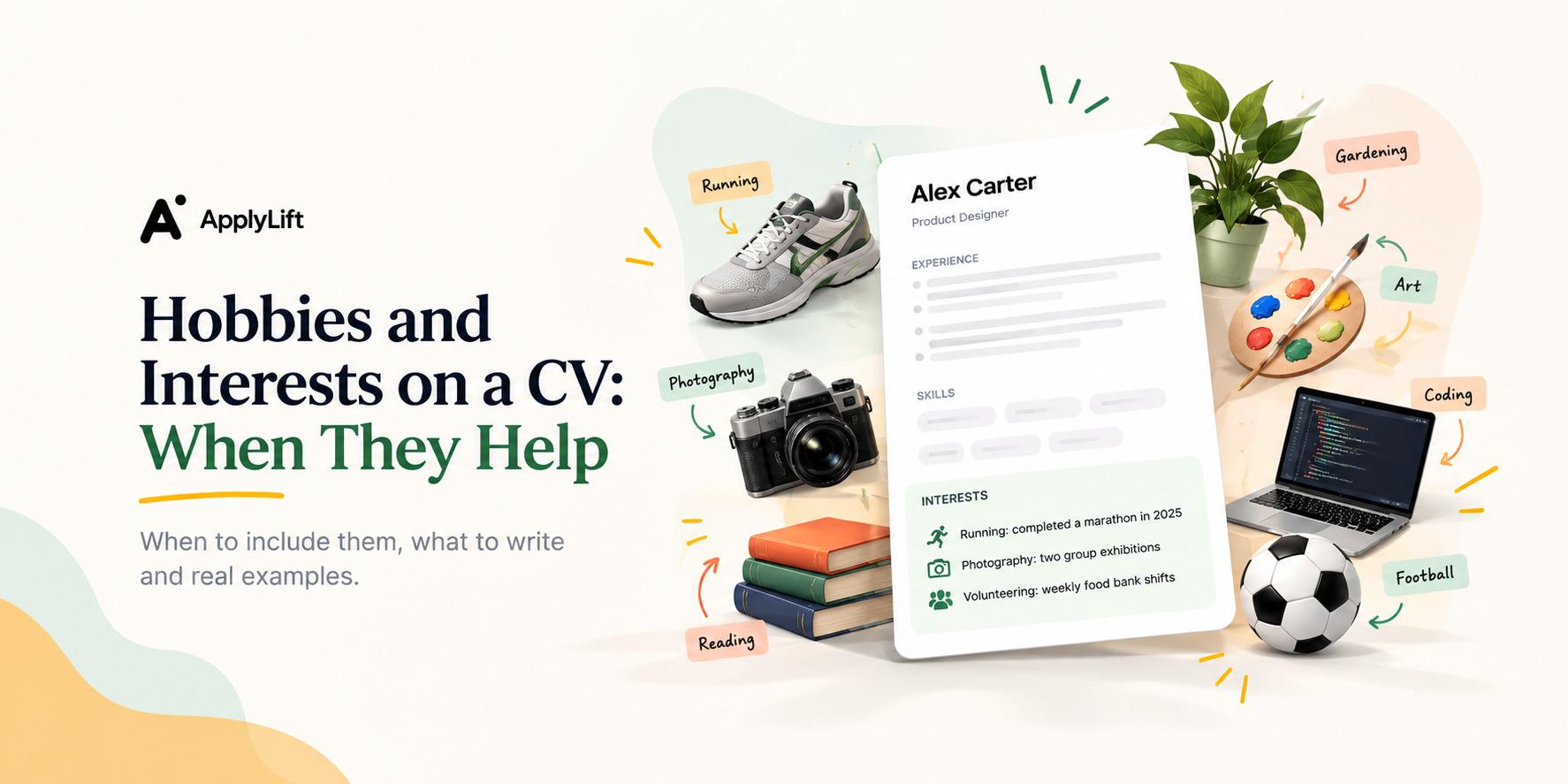
The pattern is interest plus a specific, verifiable detail or outcome.
Long-distance running: completed the Manchester Marathon in 2025, currently training for a sub-four-hour time.
Amateur football: club treasurer for three seasons, managing a 6,000 annual budget.
Chess: club player rated 1700, organise a monthly beginners' evening.
Photography: documentary portraits, two group exhibitions, all editing in Lightroom.
Home cooking: run a small Instagram account on regional Bengali recipes with 4,000 followers.
Open-source contribution: maintain a small Python library with 300 GitHub stars.
Community volunteering: weekly shifts at a food bank since 2023, coordinating six other volunteers.
Language learning: conversational Spanish, working towards B2.
Board games: designed a print-and-play game with 500 downloads.
Choir: second alto in a 60-voice community choir, two concerts a year.
Cycling: commute by bike year round; completed a 300 km charity ride in 2024.
Woodworking: furniture from reclaimed timber, sold at local markets.
Debating: university society captain; reached the national semi-finals.
Gardening: manage a community allotment plot shared by five households.
Podcasting: co-host a fortnightly show on local history, 40 episodes.
Climbing: indoor lead climber, belay certified, occasional outdoor routes.
Coding side projects: built a habit-tracking app used by 200 people.
Scouting: assistant leader for a group of 24 young people.
Writing: personal finance blog with 10,000 monthly readers.
Rowing: member of a masters crew training three mornings a week.
Each of those gives an interviewer a question and each says something about discipline, leadership, creativity or follow-through without claiming it.
How to format the section
Heading: "Interests" or "Interests and activities". "Hobbies" reads slightly childish on a professional CV; either is acceptable.
Position: last on the page, after skills and education, unless it is doing heavy lifting on a student CV, where it can sit before references.
Length: one to three lines, three to five items. Not a bulleted list of ten.
Style: interest, then detail, separated by a colon or a dash of plain text. Keep the detail to one clause.
Interests are not skills. Keep them out of the skills section, which should hold the tools and competencies the posting asks for; see how many skills to list on a resume for that section's rules.
What to do if your interests are ordinary
Skip the section. A CV without interests is normal. A CV with "reading and travelling" is faintly worse than one without, because the reader notices the filler. If you want the human touch and your interests are genuinely everyday, make one of them specific: not "reading" but "reading: mostly Cold War history, about a book a month". Specific is interesting; categories are not.
Frequently asked questions
Should I put hobbies on my CV in 2026?
Only if they are specific and add something: a skill, a talking point, or evidence of commitment on a CV with little experience. Otherwise leave the section off; nobody will miss it.
How many hobbies should I list?
Three to five, in one to three lines. More than that dilutes the good ones and eats space.
Should I put interests on a CV for a graduate job?
Usually yes. With little experience, well-chosen interests are some of the strongest evidence you have. The student and graduate CV template leaves room for them.
Do employers actually read the hobbies section?
Interviewers do, often right before the interview, looking for an opening question. Screening recruiters mostly do not. Write it for the interviewer.
Can hobbies get my CV rejected?
Rarely on their own, but a divisive or contradictory interest can cost you a borderline decision. Keep anything political, religious or risky off the page unless the role itself is about it.
Give the section its proper place
In the free CV builder, add an Interests section, drop it to the bottom of the page, and write three specific lines using the pattern above. Then check the whole page still fits and every achievement is still visible above it.