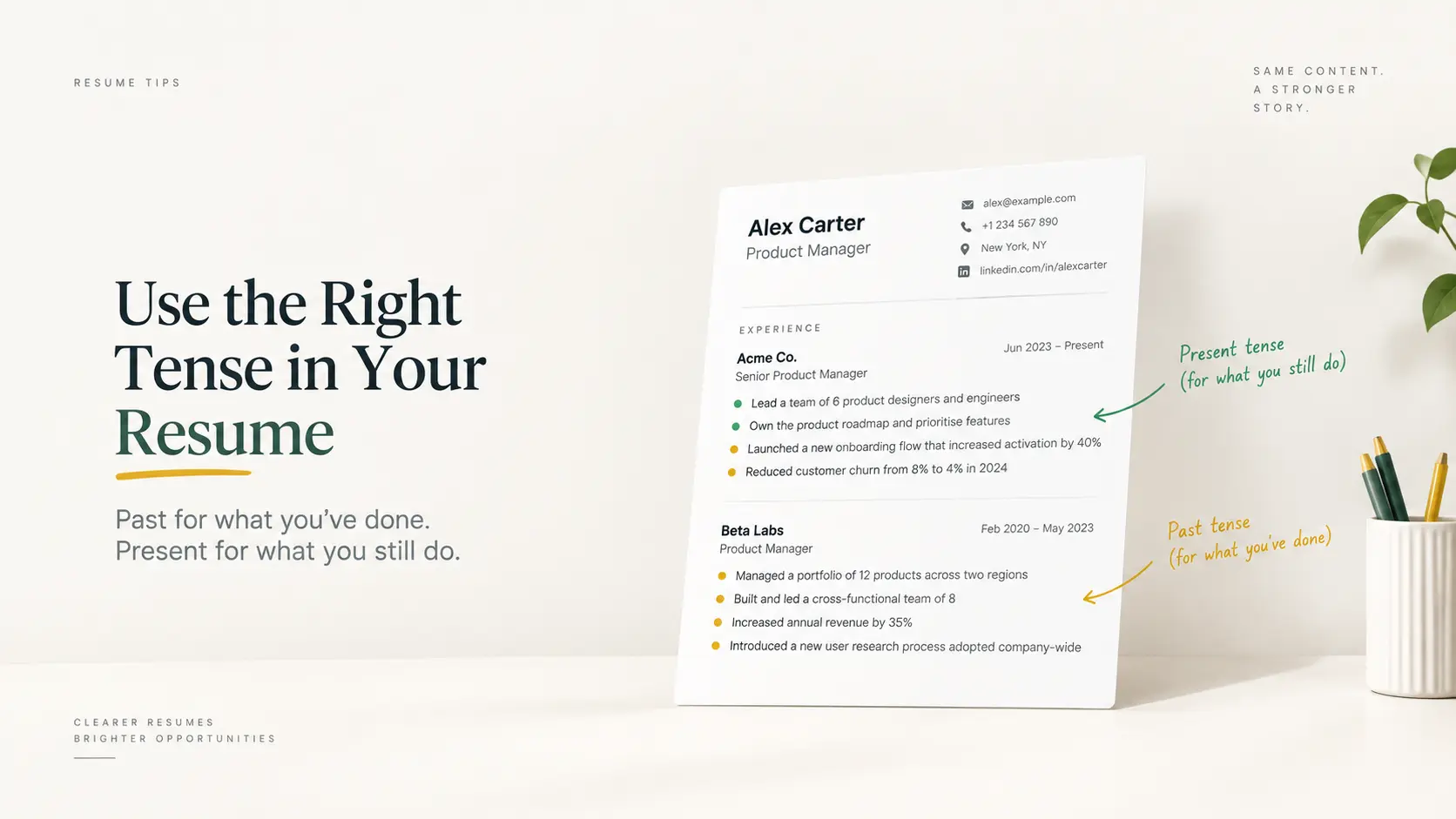
Write previous jobs in the past tense and your current job in the present tense, with one exception: anything you have already completed in your current role goes in the past tense, even though you still work there. "Manage a team of six" is present because you still do it. "Cut onboarding time from ten days to four" is past because it happened and is finished. That exception is the part most resumes (CVs) get wrong, and it is the part that makes a current-role section read like a list of duties instead of results.
The rule in one table
Previous jobs: past tense, always. "Led", "built", "reduced", "negotiated".
Current job, ongoing responsibilities: present tense. "Lead", "manage", "own", "coordinate".
Current job, completed achievements: past tense. "Launched", "delivered", "saved", "grew".
Summary or objective: present tense, no pronoun. "Product manager with eight years..." not "I am a product manager".
Education, certifications, projects you finished: past tense or no verb at all. "Completed", "graduated", or simply the credential and date.
Why the exception matters
Recruiters read your current role first and hardest. If every bullet is in the present tense, it reads as a job description: things you are supposed to do. Achievements are events, and events are told in the past tense. Compare "Increase customer retention through onboarding improvements" with "Increased customer retention from 71 to 84 percent by redesigning onboarding in 2025." The second is finished, measured and believable. Mixing tenses within your current role is not an error; it is the correct way to separate what you do from what you have done. The only mistake is mixing them randomly.
Examples: current role done right
Senior Account Manager, Northwind Retail, Jun 2023 to Present
Manage a portfolio of 22 mid-market accounts worth 3.1 million in annual revenue. (ongoing, present)
Renewed 20 of 21 accounts due in 2025, the highest retention on the team. (finished, past)
Lead quarterly business reviews with client executives. (ongoing, present)
Built the account-health dashboard the whole team now uses to flag churn risk. (finished, past)
Read that list out loud and the tenses sort themselves: the reader knows instantly what you still do and what you already achieved.
Examples: previous roles
Account Manager, Contoso Supplies, Feb 2020 to May 2023
Managed 15 accounts across two regions and grew the book by 40 percent in three years.
Introduced a quarterly review cadence later adopted company-wide.
Trained four new account managers, two of whom were promoted within a year.
Everything is past, because everything is over. Do not slip into the present tense to make an old job sound current; the dates give it away and the mismatch looks careless.
Verbs that carry each tense
The tense is easy once you start every bullet with a verb. Present-tense verbs for current duties: lead, manage, own, oversee, coordinate, maintain, advise, run, supervise, develop. Past-tense verbs for achievements anywhere: launched, delivered, built, reduced, increased, negotiated, redesigned, migrated, saved, won, shipped, resolved, secured. Avoid weak openers in either tense: "responsible for", "helped with", "worked on", "assisted in". They describe proximity to work rather than work. Paste your bullets into the free resume buzzword checker and it will flag the weak verbs and clichés for you.
Consistency inside a bullet
Whatever tense a bullet starts in, finish in it. "Manage a team of six and delivered the migration ahead of schedule" mixes an ongoing duty with a finished result in one sentence; split it into two bullets. Also keep number and voice consistent: all bullets are fragments starting with a verb, none start with "I", and none end up as full sentences with a subject.
Sections outside the experience block
Summary: present tense, describing who you are professionally. "Data analyst who turns messy operational data into decisions; five years across logistics and retail."
Skills: no verbs. Nouns only: "SQL, Tableau, dbt".
Projects: past tense if finished, present if ongoing, same rule as jobs.
Volunteering: same rule as jobs.
Education: the credential and the date. "BSc Computer Science, 2021" needs no verb. If you must, "Graduated with first-class honours".
For how these sections fit together, see how to write a resume, and for the skills section specifically, how many skills to list.
Frequently asked questions
Should my entire resume be in past tense?
No. Your current job's ongoing duties are present tense. Only previous jobs and completed achievements are past tense.
Can I mix past and present tense in my current job?
Yes, and you should: present for what you still do, past for what you have finished. Just never mix them inside one bullet.
Is it wrong to write "I" on a resume?
Convention is to leave it out. Bullets start with the verb; the reader knows the subject is you. The tense rule is the same either way.
What tense is a resume summary written in?
Present tense, third person or no pronoun. It describes your professional identity now.
Does tense affect applicant tracking systems?
Barely. Keyword matching looks for terms, and most systems match "managed" and "manage" to the same root. Tense is for the human reader, who notices it far more than the software does.
Fix the tenses in one pass
Open your resume in the free CV builder, read your current role and ask of each bullet: still doing it, or done? Change the verb to match. Then run the bullets through the buzzword checker to replace the weak openers. Ten minutes, and the top of your resume stops reading like a job description.