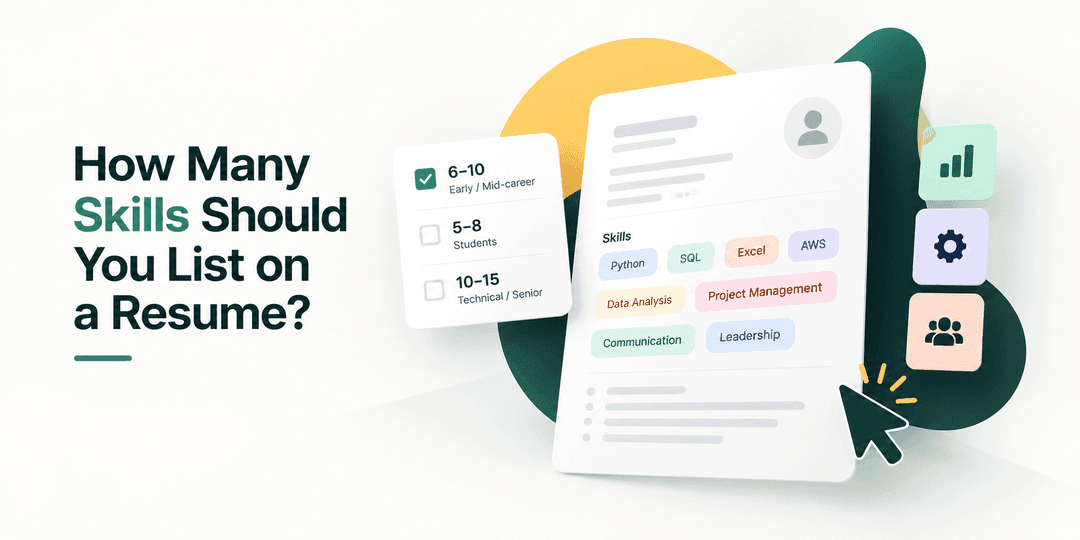
List 6 to 10 skills in your resume's skills section if you are early or mid-career, and up to 12 to 15, grouped by category, if you are in a technical or senior role. Beyond that, the list stops being read. The number that actually decides whether you get called is smaller: how many of those skills match the exact wording of the job posting.
Why listing as many skills as possible backfires
Two readers see your skills section, and a long list fails both of them.
The recruiter scans it in a few seconds looking for three or four specific things the hiring manager asked for. Twenty-five items make those three harder to find, and a list that includes "Microsoft Word" next to "financial modelling" tells them you did not know which one mattered. Padding is a signal in itself.
The applicant tracking system does not reward volume either. An ATS matches the terms a recruiter searches for or the requirements a job was set up with, and it matches wording, not intent. "Search engine optimisation" in the posting and "SEO" on your resume can register as a miss. Thirty loosely related skills do not raise your match; the eight that appear in the posting, spelled the way the posting spells them, do. Our guide to resume keywords covers how that matching works in detail.
How many skills by career stage
Student or no work experience: 5 to 8. Only hard skills you could demonstrate in an interview tomorrow: software, languages, lab or research methods, tools from coursework. A short honest list beats a long aspirational one, and interviewers at graduate employers probe exactly what is written.
Early to mid-career: 6 to 10. Enough to cover the posting's requirements with room for one or two differentiators the posting did not ask for but the team will value.
Senior or technical roles: 10 to 15, grouped. A software engineer, data analyst or nurse legitimately has more named tools, certifications and methods. Group them under two to four labels ("Languages", "Cloud", "Data") so a reader can find the category they care about in one glance. Past 15, cut or move items into the bullets where they were used.
If you are wondering which skills to put in that list rather than how many, the companion piece on what skills to put on your CV goes role by role.
Does resume length change the number?
Yes, and no other guide seems to say so. A one-page resume has a fixed budget. One line of comma-separated skills holds about 8 to 10 short items; two lines is the most a one-pager can afford without pushing experience off the page. A two-page resume for a senior or technical candidate can carry a grouped block of 12 to 15 and still leave the experience section as the largest thing on page one, which is where it belongs.
The rule of thumb: the skills section should never be taller than your most recent job entry. If it is, the list is too long or the job entry is too thin.
How to choose which skills make the cut
The job posting is the answer key. The method takes about five minutes per application:
Paste the posting into the free job description keyword finder. It pulls out the hard skills, tools and phrases the posting repeats, so you are not guessing from a skim.
Split the results into required (in the "must have" list or repeated more than once) and preferred (mentioned once, or in the "nice to have" list).
Keep only the ones you genuinely have. Half-learned skills go in a "currently learning" note or stay for the interview conversation, not the list.
Write each one using the posting's wording. If the posting says "Google Analytics 4", do not write "GA4" alone. You can write "Google Analytics 4 (GA4)" and cover both.
Fill the remaining slots with one or two strengths the posting did not mention but the role obviously needs.
Done that way, the count takes care of itself. You will usually land between 6 and 12.
Hard skills in the list, soft skills in the bullets
The skills section should be almost entirely hard skills: things that are teachable, nameable and checkable. Soft skills belong in your experience bullets, where they come with evidence. "Communication" in a list carries no information. "Presented weekly performance reviews to a 12-person sales team" proves it. If a posting leans heavily on a soft skill, such as "stakeholder management", it is fine to include that exact phrase once in the list for matching purposes, then prove it in a bullet.
Skip skill bars, stars and percentages
Progress bars and star ratings look like extra information, but most parsers extract nothing from a filled rectangle. "Python" with a bar three-quarters full is read as "Python", or not read at all if the bar is an image. Ratings also invite a question you do not want: what does 80 percent Excel mean, and why not 100? If you need to show levels, use plain text: "Python (advanced)", "Spanish (B2)", or grouped headings such as "Expert" and "Working knowledge".
Is it redundant to list a skill and also show it in a bullet?
No, it is the ideal. The skills section gives the ATS and the scanning recruiter a clean, matchable list. The bullet gives the hiring manager proof. Aim to have every skill in your list backed by at least one bullet somewhere in your experience or projects. A skill that appears nowhere else on the page is the first one to cut.
Frequently asked questions
How many skills is too many on a resume?
More than 15 in a flat list is too many for anyone. More than 10 is too many if you are early in your career or on a one-page resume. If you cannot back a skill with a bullet or an interview story, it is one too many regardless of the count.
Should I include skills I am still learning?
Not in the main list. If a posting requires it and you are actively learning, add a short line such as "Currently completing: AWS Cloud Practitioner (exam scheduled March 2026)". That is honest and still gets the keyword on the page.
Should I list Microsoft Office or basic computer skills?
Only if the posting asks for them or the role is administrative. For most professional roles they are assumed, and listing them uses a slot a real differentiator could take. Advanced Excel (pivot tables, Power Query, VBA) is different and worth naming specifically.
How many skills should an entry-level resume have?
Five to eight, all hard skills you can demonstrate. Fill the rest of the page with projects and coursework written like work experience; that is where an entry-level candidate's real evidence lives.
Do I need a skills section at all?
Almost always, yes. It is the section recruiters scan first for technical fit and the one an ATS parses most cleanly. The exception is a very senior executive resume, where a short "areas of expertise" line does the same job.
Build the list once, tailor it per job
In the free ApplyLift resume builder the skills section is a plain, parser-friendly list you can reorder in seconds, so keeping a master list of 15 and trimming to the 8 a posting asks for takes less time than reading this paragraph. Then run the result through the free ATS checker against the posting to see which required terms are still missing.