A recruiter spends about seven seconds on their first pass over your resume. In that time they are not reading, they are scanning for a reason to keep going or a reason to stop. A good resume makes that decision easy. This guide walks through exactly how to write one, section by section, with the wording choices that separate a resume that gets interviews from one that gets ignored.
What a resume is actually for
Your resume has one job: to get you the interview. It is not your autobiography and it is not a list of every task you have ever done. It is a focused argument that you can do the specific role you are applying for. Every line should either prove that or be cut.
The sections every resume needs
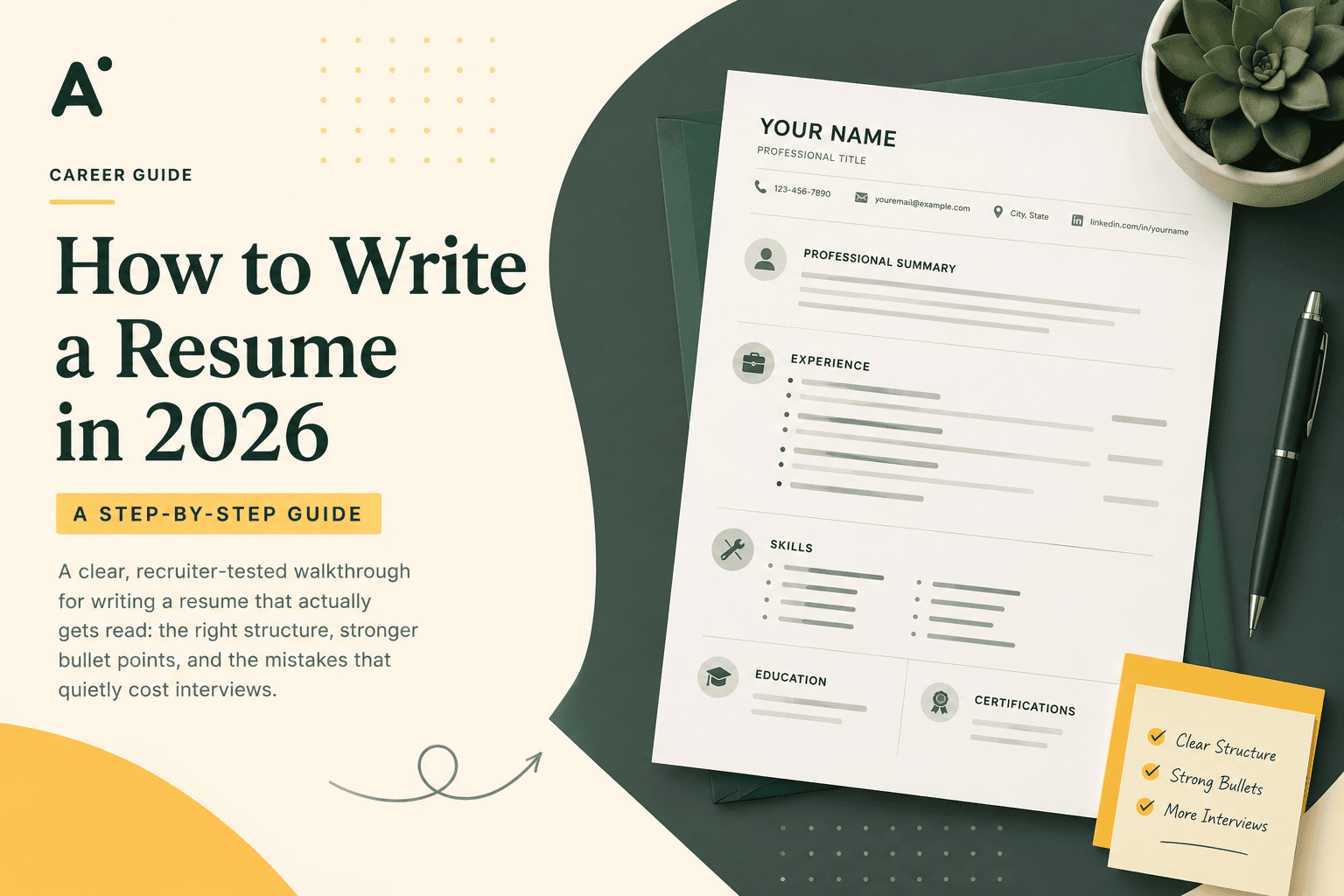
Almost every strong resume uses the same six building blocks, in roughly this order.
Contact details. Name, phone, email, city, and a LinkedIn or portfolio link. No full street address, no photo (in most countries), no date of birth.
Professional summary. Two or three lines at the top that state who you are and the value you bring. Skip the generic objective statement.
Work experience. Your most important section. Reverse chronological, most recent first.
Skills. A short, scannable list of the hard skills and tools the job asks for.
Education. Degree, institution, and graduation year. Move this above experience only if you are a recent graduate.
Extras. Certifications, languages, or projects, when they are relevant to the role.
How to write experience bullets that land
This is where most resumes fall flat. The fix is a simple formula: action verb + what you did + measurable result. Compare these two lines.
Weak: Responsible for managing the company social media accounts.
Strong: Grew Instagram following from 2,000 to 15,000 in 8 months by shipping a daily content calendar.
The second version starts with a real verb, shows ownership, and ends with a number. You do not need a metric on every line, but aim for one on your strongest achievements. If you do not have exact figures, estimates and ranges are fine as long as they are honest.
Lead with verbs, not filler
Open each bullet with a verb like Built, Led, Cut, Launched, Negotiated, or Automated. Avoid tired phrases like "responsible for", "duties included", and "hard worker". They take up space and say nothing.
Tailor the resume to the job
The single highest-leverage thing you can do is tailor. Read the job description, pull out the skills and responsibilities it repeats, and make sure your resume reflects the same language where it is true for you. A generic resume sent to 50 jobs performs worse than a tailored one sent to 10. Our free ATS resume checker shows you which keywords from a job posting your resume is missing.
Format and length
Keep it clean and simple. One page if you have under 10 years of experience, two pages at most beyond that. Use a standard font, clear section headings, and plenty of white space. Avoid tables, columns, text boxes, and graphics, which can confuse the applicant tracking systems that many employers use to scan resumes first.
Proofread like it matters, because it does
A single typo can end an otherwise strong application. Read your resume out loud, run a spell check, and then have one other person look at it. Save and send it as a PDF unless the posting asks for something else, so your formatting stays intact.
Put it together
Writing a good resume is not about clever tricks. It is about being specific, being relevant, and making the reader's job easy. Start from a clean structure, prove your value with concrete bullets, and tailor it to each role. When you are ready to build one that looks the part, our free resume builder gives you recruiter-approved templates that stay ATS-safe.