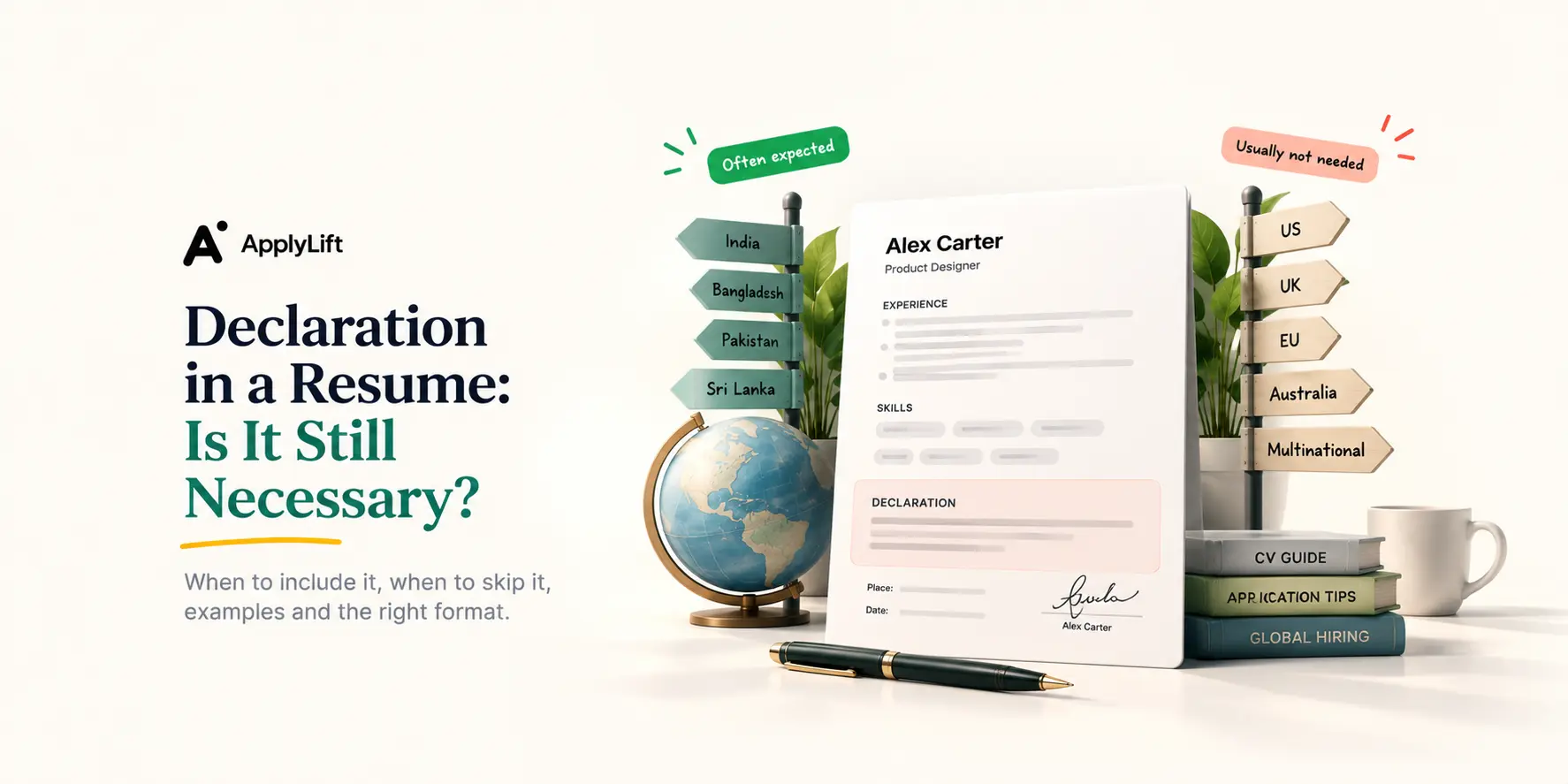
A declaration in a resume (CV) is a one-sentence statement at the very end, usually signed and dated, confirming that the information above is true to the best of your knowledge. Is it still necessary? In most of the world, no: employers in the US, UK, EU, Australia and most multinationals do not expect it and may find it old-fashioned. In much of South Asia, including India, Bangladesh, Pakistan and Sri Lanka, and in parts of the Gulf and Africa, many traditional employers, government bodies and universities still expect it, and a CV without one can look incomplete. The rule is to follow the reader, not the habit.
Check your resume while you read
Free, no signup, unlimited. Get a 0 to 100 score and the 3 things to fix first. Your resume is read in your browser, never uploaded.
What a declaration is for
Historically the declaration turned a CV into a signed document: a statement the candidate could be held to if a qualification turned out to be invented. Modern hiring has moved that function elsewhere. Application forms include a truthfulness checkbox, offer letters state that false information is grounds for dismissal, and background checks verify the facts directly. That is why Western recruiters read a declaration as a formality from another era. It is also why some traditional employers still ask for it: in hiring processes without those other safeguards, the signed line is the safeguard.
Include a declaration when
You are applying in India, Bangladesh, Pakistan, Sri Lanka or Nepal to a government body, a public-sector company, a traditional private employer, a school or a university. It is often expected, occasionally required, and never penalised.
The job advertisement or application instructions ask for a signed CV or biodata. Then it is mandatory.
You are a fresher in one of those markets. Fresher CVs there conventionally end with a declaration, and recruiters who screen hundreds of them notice when the convention is broken.
You are submitting a printed CV in person in a market where signing documents is the norm.
Leave it out when
You are applying to a US, UK, European, Australian or Canadian employer, or to a multinational's global hiring portal, wherever you live. It reads as padding and dates the CV.
You are applying through an online form that already asks you to confirm accuracy. The declaration duplicates a checkbox.
Space is tight. A declaration, a signature line and a date take four to six lines that an achievement could use.
You are applying to a startup or tech company in South Asia that follows Western hiring conventions. Check their careers page; if their sample CVs and their culture look global, skip it.
When in doubt, the cost of including it in a market that expects it is zero, and the cost of omitting it there is a raised eyebrow. In markets that do not expect it, the cost of including it is a raised eyebrow of a different kind. Follow the reader.
Five declaration examples
Standard: I hereby declare that the information given above is true and correct to the best of my knowledge and belief.
Concise: I confirm that all the information provided in this CV is accurate and complete.
With accountability: I hereby declare that the above particulars are true to the best of my knowledge, and I understand that any misrepresentation may result in the withdrawal of my application or appointment.
Fresher, formal: I solemnly declare that the details furnished above are true and correct to the best of my knowledge and that I bear the responsibility for their correctness.
Short, modern: All information in this document is true to the best of my knowledge.
Pick one. Do not combine two, and do not add a paragraph explaining your honesty; the whole point is that it is one line.
Where it goes and how it is formatted
The very last item on the CV, after references or interests.
A heading that says "Declaration", then the sentence.
Below it, left-aligned: Place and Date. Right-aligned, or below: your signature and your printed name. On a digital CV, your typed name is enough; a scanned signature image is optional and adds nothing a parser can read.
Same font and size as the body. Not italic, not boxed, not in a footer, for the reasons in do ATS systems read headers and footers.
Example block:
Declaration
I hereby declare that the information given above is true and correct to the best of my knowledge and belief.
Place: Dhaka
Date: 8 September 2026
Tanvir Ahmed
Does a declaration affect applicant tracking systems?
Barely. It parses as ordinary text at the end of the document. The only risk is a scanned signature image, which extracts as nothing, and a declaration placed in a footer, which some parsers skip. Neither harms the rest of the record. Keep it as plain text in the body and it is invisible to the software and visible to the human who expects it.
The rest of a traditional CV
A declaration usually travels with two other conventions: a career objective at the top and a personal details block (date of birth, nationality, sometimes marital status). Treat each on its own merits for the market you are in. The objective is covered in career objective for freshers; personal details belong only where local employers expect them and never on a CV headed for the US or EU, where they invite legal problems for the employer. If you are early in your career, the CV with no experience guide shows how to fill the page with evidence rather than formalities.
Frequently asked questions
Is a declaration mandatory in a resume?
Only when the employer or the application instructions ask for a signed CV. Otherwise it is a convention: expected by many traditional South Asian employers, unnecessary elsewhere.
Should freshers include a declaration?
In India, Bangladesh, Pakistan and similar markets, yes, unless the employer is a global-style tech company. In Western markets, no.
Where do I put the declaration in a resume?
At the very end, as the last section, with place, date and your name below it.
Do I need to sign the declaration?
On a printed CV, yes. On a digital CV, your typed name is the accepted equivalent; a scanned signature is optional.
Can a declaration hurt my application?
In markets that do not use it, it makes the CV look dated and wastes space, which can cost a borderline decision. It never causes a rejection on its own.
Build the version each market expects
In the free CV builder, the declaration is an optional section you can switch on for a traditional employer and off for a global one, so you keep one CV and export the right version each time. The student and graduate template is a good starting point for a fresher CV in either style.