Every CV advice article tells you to lead with your work experience, which is spectacularly unhelpful when you do not have any. Here is the reframe that makes a first CV writable: employers screening entry-level candidates are not looking for a career. They are looking for evidence of three things: you show up, you learn fast, and you produce work. Everything you have done so far, from coursework to a Saturday job, is evidence for one of those claims. Your CV's job is to present it that way.
The structure that works without a work history
A first CV is not a thin version of a professional CV. It has its own order, and the order does a lot of the work:
Contact details, including a LinkedIn or portfolio link if you have one worth showing.
A two-line summary saying what you are (final-year student, recent graduate, school leaver), your strongest proof point, and what you are looking for.
Education, with the detail a professional CV would trim: relevant modules, strong grades, coursework topics.
Projects, written exactly like job bullets. This is your experience section in disguise.
Work and volunteering, including the part-time jobs you were tempted to leave off.
Skills, backed by where you used them.
Recruiters at graduate employers read in roughly this order too, so you are matching the scan, not fighting it.
Education: your headline section
With no career to describe, your education carries the load, so give it real detail. Name your degree or qualifications with dates and grades (include your predicted grade if it is good). Then add two to four relevant modules or coursework pieces, chosen to match the jobs you are applying for. A line like "Relevant modules: Statistics (78%), Marketing Analytics (74%)" does the same job that experience bullets do for a professional: it is specific, checkable, and relevant.
Projects are experience. Write them that way.
A dissertation, a coursework build, a hackathon entry, a fundraiser you organized, or a personal project all count, if you write them like work. Use the same formula as a job bullet: what you did, how, and what came of it.
Weak: "Final-year project on demand forecasting."
Strong: "Built a demand-forecasting model in Python on three years of retail data; graded 78% and shortlisted for the department prize."
Two or three projects described at that level of detail beat a long list of titles. If a project is live or public, link it. If it had a result of any kind, a grade, users, money raised, attendance, put the number in.
The part-time job you were about to leave off
Bar work, retail shifts, tutoring, and delivery jobs carry more weight than most students think, because they are direct evidence of the thing employers worry about most with a first hire: reliability. Working 6am shifts through exam season answers that question better than any personality adjective. Keep these entries short, one or two bullets, and give each one something concrete: tills you balanced, new starters you trained, the busiest shifts you handled.
Society and volunteer roles convert even better, because they usually involve real ownership. "Treasurer of the 200-member Computing Society: managed a £4k budget across 12 events" is a management bullet, whoever wrote it.
Skills, without making them up
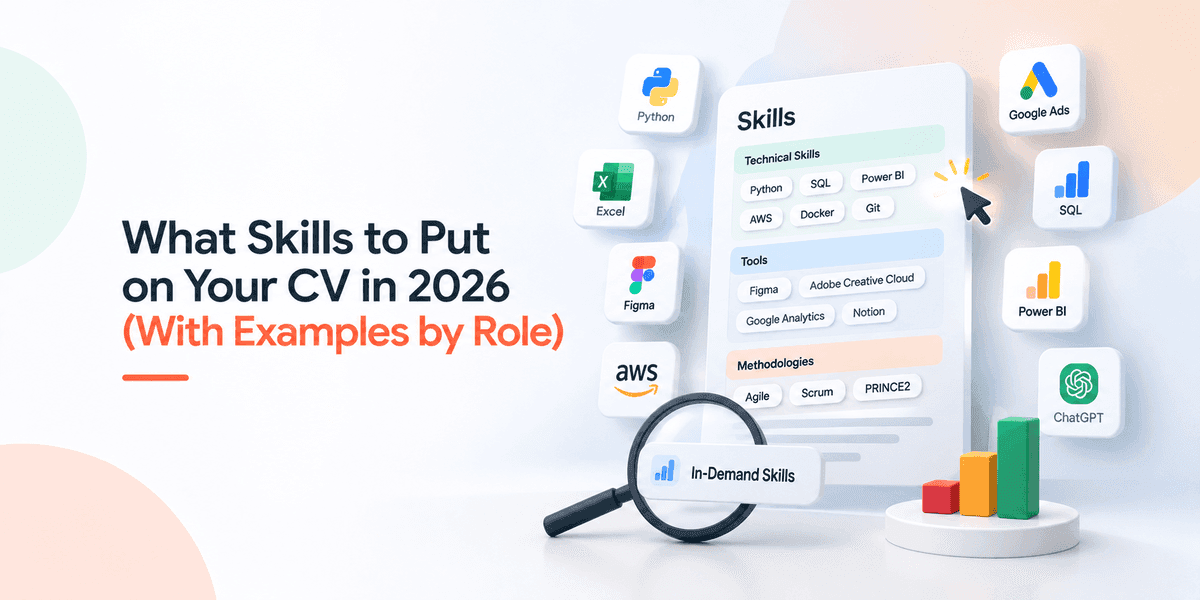
List the hard skills you can actually defend in an interview: software, languages, tools, techniques from coursework. Attach each to its evidence where you can. Skip the self-assessed soft-skills list ("team player, hard-working, good communicator"); those claims carry no information on their own. If teamwork is your strength, the group project bullet proves it better than the word does.
What to cut
The objective statement ("Seeking a challenging position where..."). Your summary already covers this without the boilerplate.
School-level detail once you have higher qualifications. One line is enough.
Hobbies that say nothing ("socializing, music, films"). Keep interests only if they are specific enough to start a conversation.
"References available on request." Employers assume it.
And keep it to one page, strictly. A padded second page tells a recruiter you could not tell what mattered, which is its own signal.
Never fake it
Do not invent job titles, stretch dates, or claim skills you cannot use. Entry-level interviews probe exactly what is on the page, and the cost of getting caught is the whole application. The honest version of your CV, structured well, is stronger than you think it is.
Start from a structure built for this
If you want the layout handled for you, our student and graduate CV template comes with example content structured exactly as this guide describes, previewed live before you sign up. Build it in the free CV builder, and when you start applying, the free ATS checker will show you which keywords each job wants that your CV is missing.