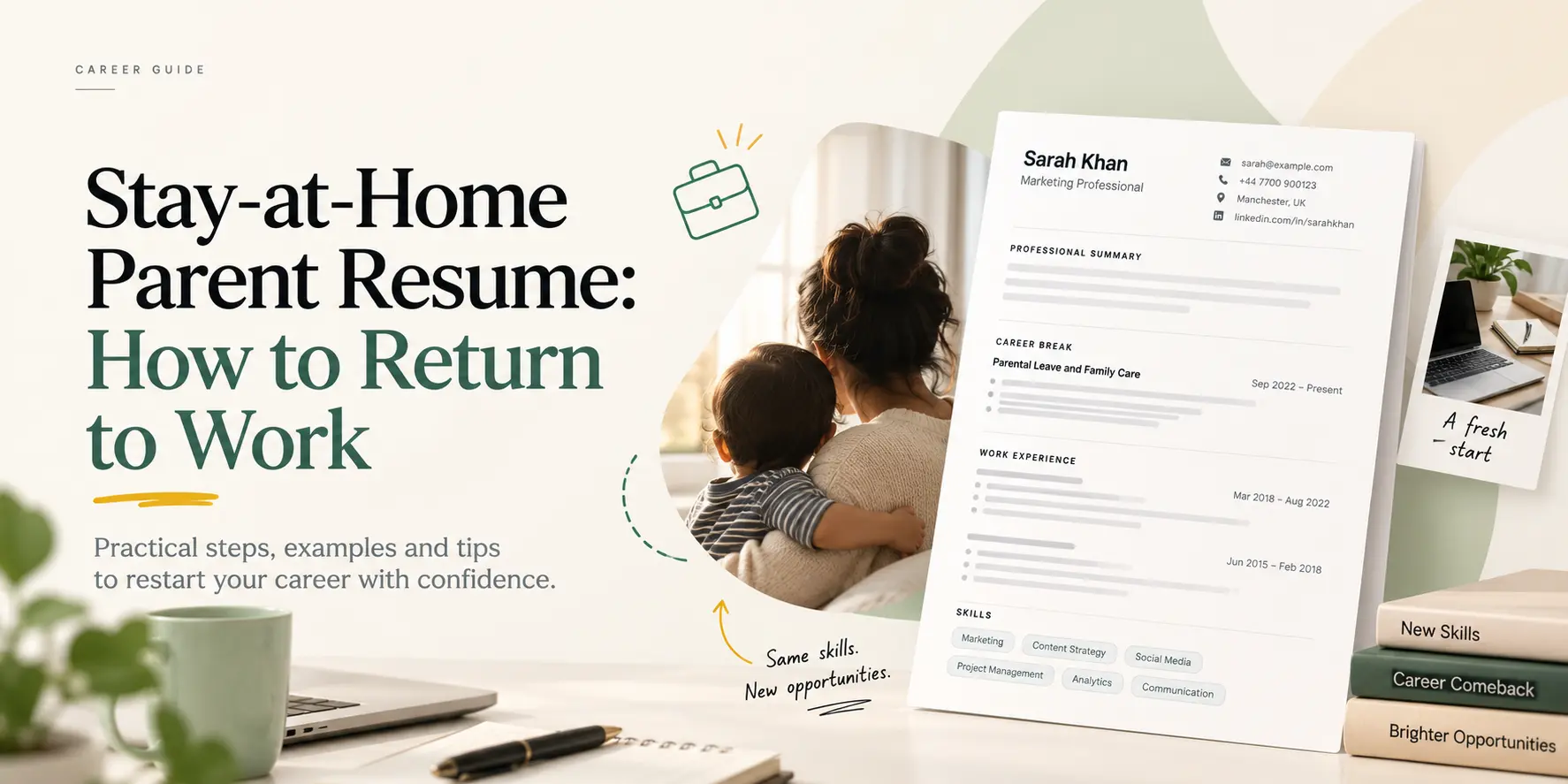
A stay-at-home parent resume (CV) works when it does three things: states in the summary that you are returning to a specific kind of role, lists the career break as a single dated line so nobody has to hunt for the gap, and gives real evidence of what you can do now, from your earlier career and from anything genuine you did during the break. What it must not do is apologise, hide the dates, or dress up parenting as "Chief Household Officer". Recruiters have seen thousands of career breaks. The ones that worry them are the ones that look concealed.
Start with the summary, not the gap
The first three lines decide how the reader frames everything below. Name the role you are returning to, your relevant experience before the break, and the fact of the return, in that order. Two examples:
"Marketing manager with seven years in consumer brands, returning to work after a three-year career break. Led campaign teams of up to five and managed budgets to 1.2 million. Current on paid social and analytics through recent coursework and freelance projects."
"Registered nurse returning to acute care after a four-year break to raise two children. Eight years of medical-surgical experience; licence active and refresher course completed in 2026."
Notice what is missing: no "despite", no "although", no "I am confident that". The break is a fact stated once. The rest of the summary is about the work.
How to list the career break itself
Put it in the experience section, in chronological position, as one entry with dates and one line of text. Recruiters read dates first; an unexplained gap makes them stop and speculate, while a labelled one makes them move on.
Career break, parental leave and family care, Sep 2022 to Present
Full-time parent to two children. Completed a data analytics certificate (2025) and freelance bookkeeping for two local businesses (details below).
That is enough. Do not list parenting tasks as bullets. "Managed household logistics and budgets" is true and every reader knows it is padding. If you did nothing work-related during the break, the single line with dates is still the right entry; it is honest and it closes the question. Including the months matters here more than anywhere else, for the reasons in should you include months on your resume.
What from the break belongs on the resume
Only things you actually did, described the way you would describe paid work:
Freelance or part-time work, even small. "Freelance bookkeeper for two small businesses, 2024 to present: monthly reconciliations, VAT returns, payroll for six staff."
Volunteer roles with real responsibility. Treasurer of a school parents' association who managed a 40,000 budget is a finance line. Helping at a bake sale is not.
Courses and certifications completed during the break, with dates. They show the skills are current.
Relevant projects. Built a website for a community group, ran a fundraising campaign, organised a 200-person event. Describe outcome and scale.
Leave out anything you would be embarrassed to explain in detail in an interview. The test is simple: would you list it if the gap did not exist?
Choose the format that shows the most
Reverse chronological is still right for most returners with a solid earlier career. The break is one entry; your last job is right below it, fully detailed.
A skills-led summary above a chronological list (sometimes called hybrid) helps when the break is long or you are changing direction. A short "Core skills" block after the summary lets the reader see what you can do before they reach the dates.
Avoid the purely functional resume that hides all dates. Recruiters distrust it, and applicant tracking systems parse it badly. It signals concealment more loudly than any gap.
Detail your last two or three roles fully. Older roles can compress to a line each. The structure of the whole page is covered in how to write a resume.
Refresh the skills section deliberately
Tools change in three years. List the versions and tools the postings ask for now, and make sure each one is true: a refresher course, a personal project, or recent freelance use counts; having used the 2021 version does not. If you are missing one that appears in every posting, a two-week online course before you apply is often worth more than another month of applications.
The example, assembled
Priya Raman
Marketing manager | priya@example.com | 07700 900000 | Manchester
Summary
Marketing manager with seven years in consumer brands, returning to work after a three-year career break. Led campaign teams of up to five and managed budgets to 1.2 million. Current on paid social, GA4 and Meta Ads through 2026 coursework and freelance client work.
Experience
Career break, parental leave, Sep 2022 to Present
Full-time parent. Freelance social media management for two local retailers since 2025 (paid campaigns to 3,000 per month; both clients renewed). Completed Google Digital Marketing certificate, 2026.
Marketing Manager, Brightwater Foods, Mar 2018 to Aug 2022
Led a team of five across brand and digital. Grew online revenue share from 12 to 31 percent in four years. Launched two product lines with combined first-year sales of 2.4 million.
Everything is dated, nothing is hidden, and the most recent paid work sits inside the break entry where a reader expects to find it.
The cover letter and the interview
One sentence in the letter, early: "I took a career break from 2022 to 2025 to raise my children and am returning to marketing full time." Then move to why this role. In the interview, when asked, give the same sentence and one line on how you kept current. Do not volunteer more; the interviewer wants to know you are ready, not to hear the whole story. Confidence is the absence of apology, not the presence of justification.
Frequently asked questions
Should I list stay-at-home parenting as a job on my resume?
List it as a career break with dates and one line, in the experience section. Do not give it a job title or duty bullets; recruiters read that as padding.
How do I explain a long gap of five or more years?
The same way: one dated line. Then make the skills section and any recent courses or freelance work do the talking. A refresher certificate dated this year answers "are you current" better than any sentence.
Should I use a functional resume to hide the gap?
No. Recruiters recognise the format as a concealment strategy and applicant tracking systems parse it badly. A visible, labelled break is stronger.
Do I mention the break in the cover letter?
Yes, in one calm sentence near the start, then move on to why you want this job. Answering the question before it is asked is the whole point.
Can I include volunteering from the break?
If it involved real responsibility, scale or skills, yes, described like paid work with outcomes. Leave out casual helping.
Build it without the wrestling
The free CV builder lets you add the career break as a normal dated entry, put freelance work inside it, and drop your earlier roles in below, with a summary block at the top and clean dates throughout. Pick a template, paste the summary above, and adapt it to your own return.