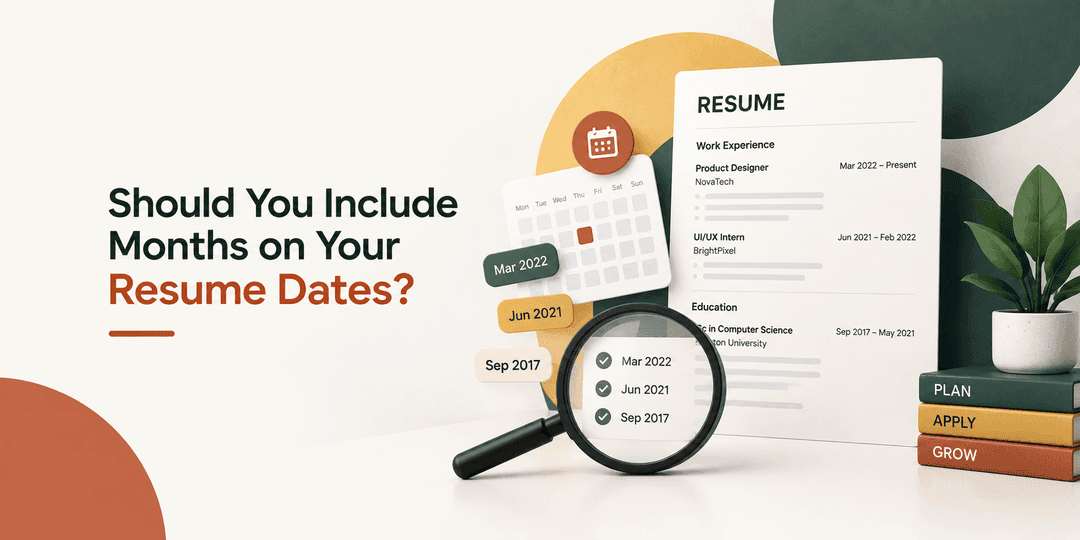
List a degree in progress exactly like a finished one, with one change: replace the graduation date with "Expected" plus the month and year. For example: Bachelor of Science in Computer Science, University of Dhaka, Expected June 2027. Include the month, never just the year. If you will not finish the degree, leave the date off entirely and state the credits or coursework you completed. Below are copy-ready formats for every situation, and the honesty rules that keep an unfinished degree from becoming a problem later.
The four situations, and which format each one gets
Enrolled and finishing on schedule → degree, institution, "Expected [Month] [Year]".
Enrolled but part-time, paused or with no fixed end date → degree with "(In progress)" after it, or "Expected [Year]" if you can commit to a year.
Not finishing, but the coursework is relevant → institution, dates attended, "Completed [N] credits toward [degree]" plus relevant coursework. No graduation date.
Not finishing, and it is irrelevant to the job → leave it off, unless you need it to explain a gap in your timeline.
Format 1: degree in progress with an expected date
The convention is the same on both sides of the Atlantic, with a word swap. US and international resumes use "Expected"; UK CVs use "Expected" or "Anticipated" interchangeably. No comma between month and year, no punctuation after "Expected".
Bachelor of Business Administration, Marketing
North South University, Dhaka
Expected December 2026 · CGPA 3.72 / 4.00
BA (Hons) English Literature
University of Leeds
Anticipated graduation: July 2027
Always give the month. A year alone forces the recruiter to guess whether you are available in January or December, and on graduate schemes with fixed start dates that guess can cost you the interview. If you do not know the exact month, use the end of your final term: May or June for spring, August for summer, December for autumn.
Format 2: enrolled, but part-time or without a fixed end date
If you are studying alongside a full-time job, or your programme is self-paced, "Expected" with a month promises something you cannot control. Use "(In progress)" on the degree line, add a year if you are reasonably sure of it, and move the education section below your work experience, because the job is now your stronger evidence.
MBA (In progress), Institute of Business Administration, University of Dhaka
Part-time, expected 2027
The same format works for a master's you are completing while working. Add "Employer-sponsored" only if it is true and the sponsorship says something about how your current employer rates you.
Format 3: a degree you will not finish
Never write "incomplete", "unfinished" or "dropped out" on the resume. The format says it for you: an institution with dates and no graduation line is understood by every recruiter. State what you did complete, because credits and coursework are real qualifications.
University of Michigan, Ann Arbor, 2019 to 2021
Completed 72 credits toward a BS in Environmental Science
Relevant coursework: Statistics, GIS, Environmental Policy
If the coursework is irrelevant to the jobs you are applying for and your work history already fills the page, you may omit the programme entirely. Omitting is not dishonest. Implying you graduated is. That means no "Graduated 2021", no degree abbreviation after your name, and an accurate answer if an application form asks directly whether you hold the degree.
Format 4: transferred, or switched programmes
List the programme you are completing as normal, then the earlier institution as a short line with dates and a note, so the timeline has no unexplained gap.
BSc Computer Science, BRAC University, Expected June 2027
Previously: Daffodil International University, 2022 to 2023 (transferred, 34 credits)
Should you include your GPA before you graduate?
Two rules everyone agrees on, and one they do not. Everyone agrees you should report only the GPA you have earned so far, never a projection, and that you should show the scale ("3.72 / 4.00"), because a 3.6 means different things on different scales. The disagreement is the cutoff: some career sites say include it above 3.0, most say above 3.5. A sensible way to decide: include it if it is above 3.5, include it above 3.0 if you are early in the programme or the employer's application asks for it, and leave it off below that. A recruiter who wants it will ask.
Where the education section goes
While you are a student or within about a year of finishing, education sits at the top of the resume, directly under your summary, because it is your main evidence and it explains your timeline. Once you have a year or more of relevant full-time work, it drops below experience. A degree in progress alongside a full-time job goes at the bottom too; the job is the headline.
If you are a student with little or no work history, the education entry can carry more detail than a professional's would: three or four relevant modules, a strong project, a thesis title. Our guide to writing a CV with no experience shows how to make that section do the work experience normally does.
International students
Two additions help a recruiter who does not know your institution. First, add the country if the city alone will not place it ("Dhaka, Bangladesh"). Second, add context to your grading scale, since a CGPA out of 4.00 and a first-class honours degree mean nothing to each other's readers. If your visa status affects when you can start or how long you can work, put a single neutral line near your contact details ("Eligible to work in the US on OPT from June 2027") rather than in the education entry. It answers the question the recruiter is already asking.
Honesty rules that protect you later
Never invent a graduation month. Use the end of your final term.
Never project a GPA. Report the one on your transcript today.
Never let the format imply completion. No past-tense "graduated", no degree letters after your name until they are yours.
If an application form asks "Do you hold a bachelor's degree?", the answer is no until it is yes, however the resume is worded.
Keep the date format consistent with the rest of the resume. If jobs use "Jan 2024 to Mar 2025", education uses month and year too.
Background checks verify degrees routinely. An honest "expected" line is never a problem in one; an implied completion is a withdrawn offer.
Frequently asked questions
Should I put my expected graduation date on my resume?
Yes, whenever you are enrolled and intend to finish. It tells the employer when you are available and prevents them from assuming the degree is already complete.
"Expected" or "Anticipated"?
Both are correct. "Expected" is more common on US and international resumes; UK CVs use either. Pick one and use it consistently.
How do I list a degree I did not finish?
Institution, dates attended, and "Completed [N] credits toward [degree]" with relevant coursework. No graduation date, and none of the words "incomplete" or "dropped out".
Can I include relevant coursework while the degree is in progress?
Yes, and for students it is often the strongest part of the entry. Three or four modules that match the job, with grades if they are good.
Does the ATS understand "Expected May 2027"?
Month-and-year dates are the standard format parsers look for, so yes. What confuses parsers is inconsistency: a year-only date in one entry and full dates in another. Keep every date in the same format.
Format it once and stop worrying about it
The student and graduate CV template is built around an education-first layout with an expected date, relevant modules and a projects section written like experience, and you can preview it with example content before you sign up. Build yours in the free resume builder, and the rest of the structure in our guide on how to write a resume follows from there.