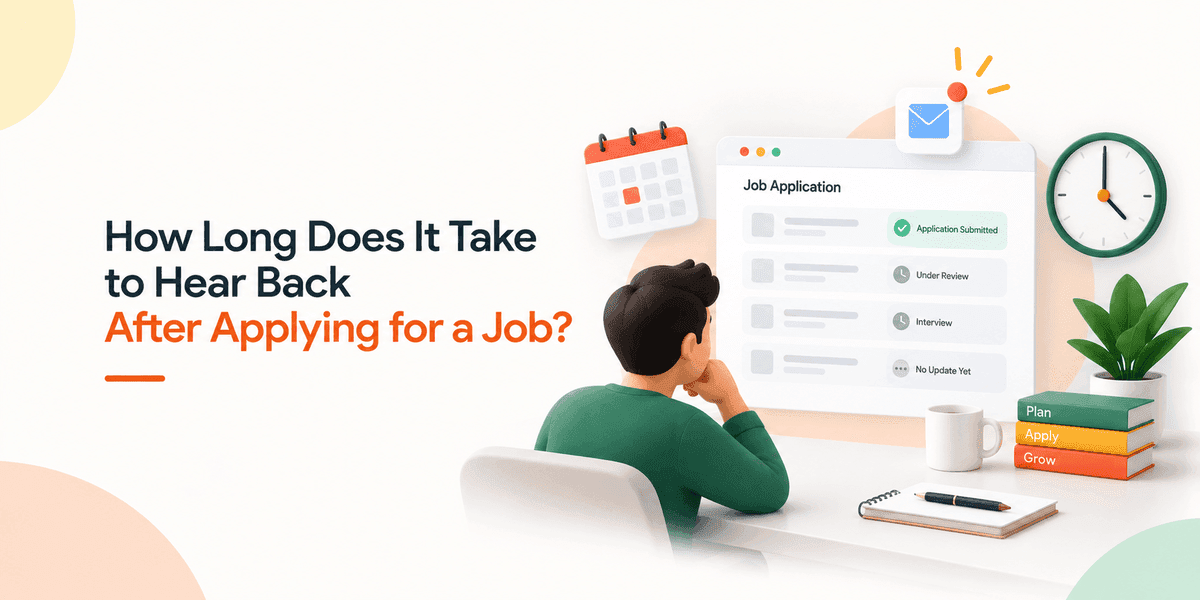
If you are going to hear back, it usually happens within one to two weeks of applying. Small companies and agency recruiters often reply within days; large corporations take two to six weeks; government and university hiring can take one to three months. Silence for three to four weeks does not always mean rejection, but it does mean you should stop waiting on that role and keep applying. Here is what the real data says, what the portal status actually means, and when a follow-up helps.
Two different numbers people confuse
Most articles on this question blend two very different measurements, so the figures sound worse than they are.
Time to first response is what you are asking about: how long until a recruiter emails, calls or schedules a screen. There is no authoritative industry study of this number. The most specific figure available comes from one job-search platform's analysis of its own users, which found a median of roughly a week for the first interview-related contact. Treat that as one company's data, not an industry fact, but it matches what recruiters describe: a first pass on applications within the first week or two of a posting going live.
Time to hire is the whole pipeline, from the job opening to an accepted offer, and it is measured properly. SHRM's 2026 benchmarking survey of over four thousand HR professionals put the median time to fill a non-executive role at 39 days, down from 44 the year before. SmartRecruiters' 2025 to 2026 benchmark, drawn from around 90 million applications, found a global median time to hire of 38 days, 35 in the US and 40 in the UK, with retail fastest at 25 days and manufacturing slowest at 55. Glassdoor's widely quoted figure of about 24 days for the interview process dates from 2017 and is rarely labelled as such, but its industry breakdown still holds directionally: government was the slowest sector at nearly 54 days, restaurants the fastest at around 10.
So a five-week wait for a decision is normal. A five-week wait for any first contact usually means you are not in the shortlist for that role.
Typical first-response timelines by employer type
These are the ranges recruiters and career advisers consistently describe, not measured averages, so use them as expectations rather than deadlines.
Agency or third-party recruiters: one to three business days if your profile matches an open brief. They are paid on placements and move fast.
Startups and small companies: three to seven business days when the role is genuinely active. Often the hiring manager reads applications personally.
Mid-sized companies: one to three weeks. A recruiter batches screening around the hiring manager's calendar.
Large corporations: two to six weeks, longer for global companies with several approval layers, and longer again if the posting attracted hundreds of applicants.
Government and public sector: four to eight weeks for a first response is common, and full processes run into months because of eligibility checks, panel scheduling and fixed procedures.
Universities and research roles: search committees work on academic calendars; a first response can take one to three months and a decision a full term.
Senior and specialist roles anywhere: add two to four weeks at every stage. More stakeholders, more rounds.
Two things slow every category: application volume, which is highest for remote roles and well-known brands, and the calendar. Late November to early January and the weeks around a company's financial year-end are quiet for decisions even when postings stay live.
What "under review" or "in progress" actually means
Less than you hope. Application portals update statuses in batches, and "under review" or "in progress" usually means your application is in the queue, not that a person has read it. Statuses also go stale: a role can be filled while the portal still shows "in review" for everyone else, and "not selected" often arrives weeks after the decision was made. Use the day count, not the wording, to decide when to follow up. The one status that carries real information is a change: "interview" or "assessment" means a human acted.
Why silence is usually not about you
Being ignored feels personal. Most of the time it is a process outcome:
Volume. A recruiter working through several hundred applications reaches a shortlist long before reaching the end of the list. Applying in the first few days matters more than most people realise.
An internal candidate. Some roles are posted externally because policy requires it while an internal hire is already agreed. The posting stays live; nothing happens.
A freeze or a reorganisation. Budgets get pulled after a role opens, or the hiring manager leaves, and nobody closes the posting.
Pipeline postings. Some employers keep evergreen postings open to collect candidates for future roles.
Caution about rejections. Many companies do not explain rejections for legal reasons, and some do not send them at all until the role closes.
None of those are fixable from your side, which is exactly why you should never wait on one application. Silence can also mean your resume never surfaced in the recruiter's search, which is a different problem and a fixable one; our post on why resumes get rejected before a human reads them explains how to check.
When and how to follow up
When: if the posting or the confirmation email gave a timeline, wait until it has passed. Otherwise, follow up seven to ten business days after applying. After an interview, three to five business days past the date they said you would hear.
How: email a person, not the portal. The recruiter named in the posting, the person who confirmed your application, or the hiring manager if you can identify them. LinkedIn is the fallback if email gets no reply, three or four days later. Do not resubmit through the portal and do not phone unless the posting invites calls.
How many times: once is standard, twice is the maximum. A third message costs you more than it gains.
Keep it to four sentences:
Subject: Following up: Data Analyst application, Farhan Ahmed
Hello Ms. Chen,
I applied for the Data Analyst role on 14 August and wanted to confirm my application reached you. I remain very interested; the reporting migration described in the posting is close to the work I led at Meridian last year. Happy to share anything further that would help. Thank you for your time.
Best regards,
Farhan Ahmed · +880 17 0000 0000
When to move on
For entry and mid-level roles, three to four weeks of silence after applying, including one unanswered follow-up, is the point to mentally close the application. For senior roles, five to eight weeks. Moving on does not mean withdrawing; leave it open in your tracker and be pleasantly surprised if it wakes up. It means the role no longer occupies your attention or slows your other applications.
What to do while you wait
Keep applying. The single biggest mistake is pausing the search while one promising application sits in a queue. Aim to have several live at once so no single silence matters.
Track it. A simple sheet with company, role, date applied, status and a next-action date turns "have I heard back yet" into a calendar entry instead of a daily worry.
Improve the next application instead of refreshing the inbox. Run your resume and the next posting through the free ATS resume checker to see which required terms you are missing, and read how resume keywords affect where you land in a recruiter's search.
Prepare as if the call is coming. Research the company, draft answers to the obvious questions, so a screen scheduled for tomorrow is not a scramble.
Frequently asked questions
Does no response after applying mean I was rejected?
Not necessarily, especially inside the first two weeks. After three to four weeks with no reply to a follow-up, treat it as a no for planning purposes while leaving it open.
How long does it take to hear back after an interview?
Usually one to two weeks, longer if further rounds involve several interviewers. Ask at the end of the interview when you should expect to hear, then follow up three to five business days after that date passes.
Is it OK to follow up twice?
Yes. Once by email around day seven to ten, once more by email or LinkedIn a week later. Then stop.
Should I call the company?
Only if the posting invites calls or the role is one where phone manner is part of the job. For most professional roles email is expected and a call is an interruption.
How long do government job applications take?
Longer than anything else. A first response in four to eight weeks is normal, and the full process often runs three to six months because of eligibility verification and fixed panel procedures.
Make the waiting time count
You cannot speed up a recruiter's queue, but you can make sure the next application is not the one that stalls. Paste the posting and your resume into the free ATS resume checker before you submit; it takes a minute and shows you exactly which of the posting's requirements your resume does not yet mention.